CREATIVE TECHNOLOGY
The Motor Orchestra
Four industrial motors, four musical voices, one instrument.
july 2026
—Stepper motors are built to be precise and, ideally, silent. During my internship at Curiosity Lab, IIT Gandhinagar, I turned four of them into a working instrument, where each motor plays its own part and together they perform a full musical arrangement.
ROLE
CONCEPT, CIRCUIT DESIGN, EMBEDDED PROGRAMMING, PYTHON TOOLING, ACOUSTIC TUNING

Project Overview
Turning the hum of 3D printer motors into polyphonic music.
Every stepper motor makes a sound as it moves. Each electrical pulse nudges it one step, and those tiny vibrations add up to a tone. Send 440 pulses a second and the motor hums an A, the same note an orchestra tunes to. The pulse rate is the pitch. This project takes that accidental noise and makes it playable.
The goal wasn't just to make motors beep in unison. It was true polyphony: melody, bass, arpeggio, and counter-melody, each motor playing its own line so the ensemble sounds like an arrangement, not four machines making the same noise.
Approach

Fashion shooting in the studio
The first version failed, and that failure shaped everything. Two motors driven with simple timing loops produced a muddy blur, because the Arduino could only serve one motor at a time and kept switching between them. No amount of tuning could fix it; the problem was the structure.
The solution was to rebuild the firmware around a hardware timer that fires 25,000 times a second, checking every motor on each tick. Pulse timing now runs quietly in the background, so all four motors can play independently, and adding another motor takes just one line of code.
Process
Built one motor at a time. Each stage was tested before the next was added, so every fault could be traced to the last change.
After persistent wiring faults, I took the whole circuit apart and rebuilt it in seven verified stages: one motor spinning, one motor playing a scale, two in unison, two playing different parts, and up to all four. Problems that had taken hours to find were located in minutes. From there I tuned the sound, finding that motors sing clearest between roughly 250 and 800 Hz, and that finer microstepping isn't always better, since it smooths the tone but weakens the bass. Finally, I wrote a Python tool that converts any MIDI file into music the machine can play, automatically splitting each song across the four motors.


The same noise engineers spend years trying to silence became the instrument itself.
Final Design
New media art
Interaction Design
creative technology
Physical Computing
Sound Art
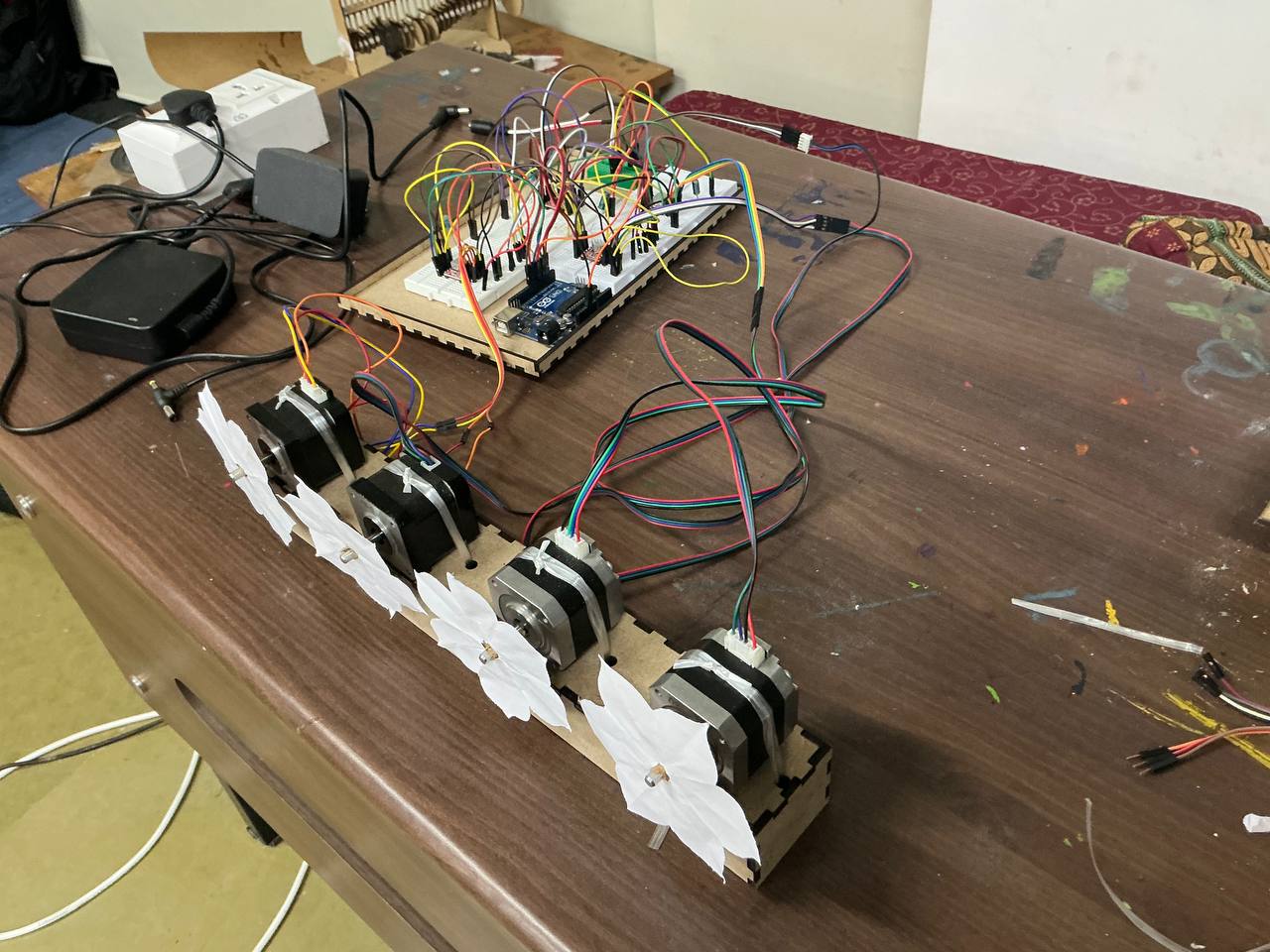
The finished instrument plays four-part arrangements, including a rock riff and a piano piece with a flowing arpeggio, with each motor holding its own voice. Songs can be changed simply by converting a new MIDI file, turning a one-off demo into an instrument with an open repertoire. Paper flowers on each motor turn the sound into visible motion, so you can watch which voice is playing as you hear it.
Beyond the machine itself, the project produced a complete build guide, a tuning reference, and a catalogue of every fault encountered with its fix, so anyone can rebuild or extend it.
Product Images